Wolf Range Repair
Wolf Range Burner Clicks But Will Not Light
When a Wolf burner clicks and clicks but never catches, the igniter itself is rarely the culprit. What the click proves, the three checks Wolf itself lists before a call, and the point where it turns into a gas job.
Rafael Monteiro Cooking-appliance technician — ventilation and blowers · 9 years in the trade
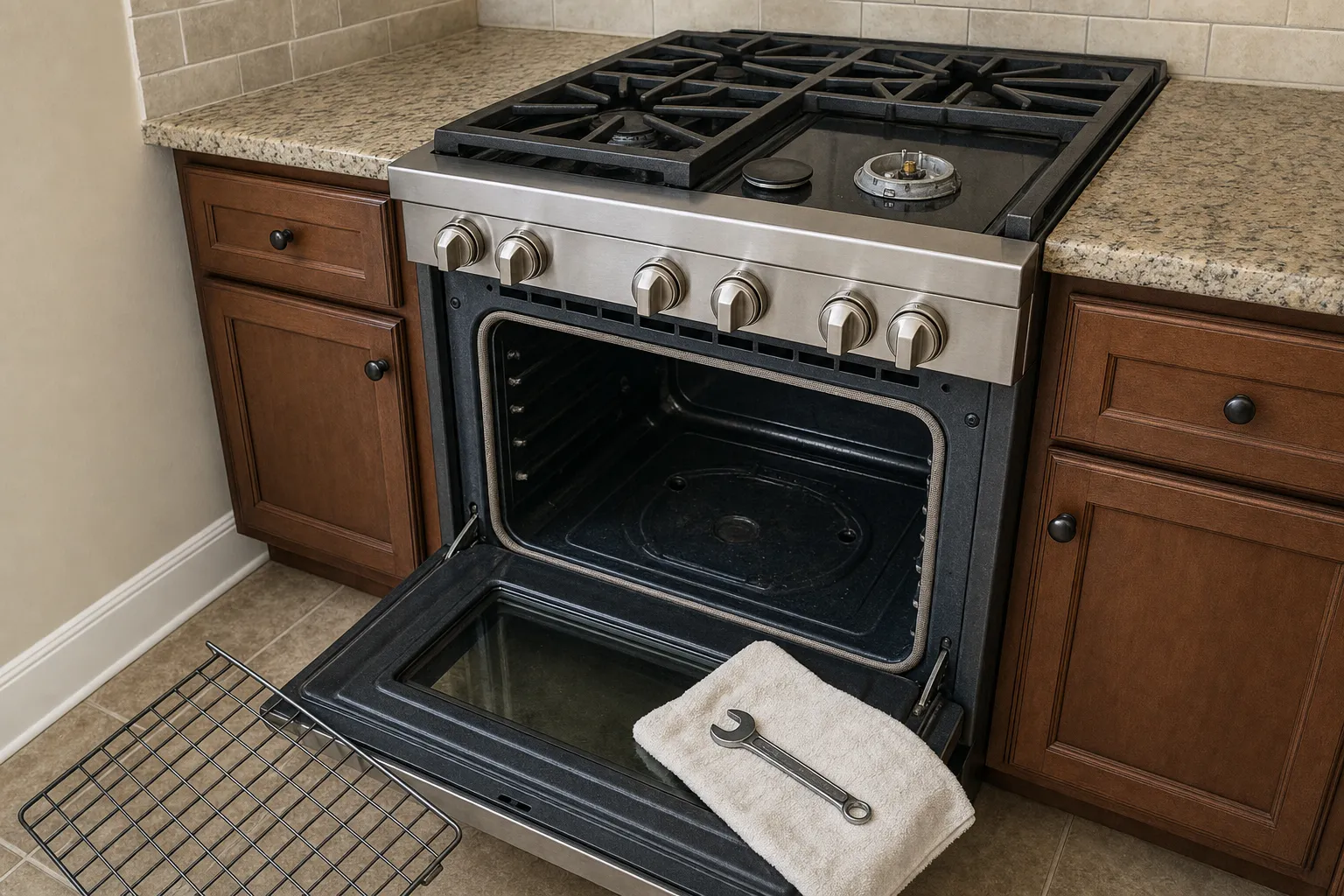
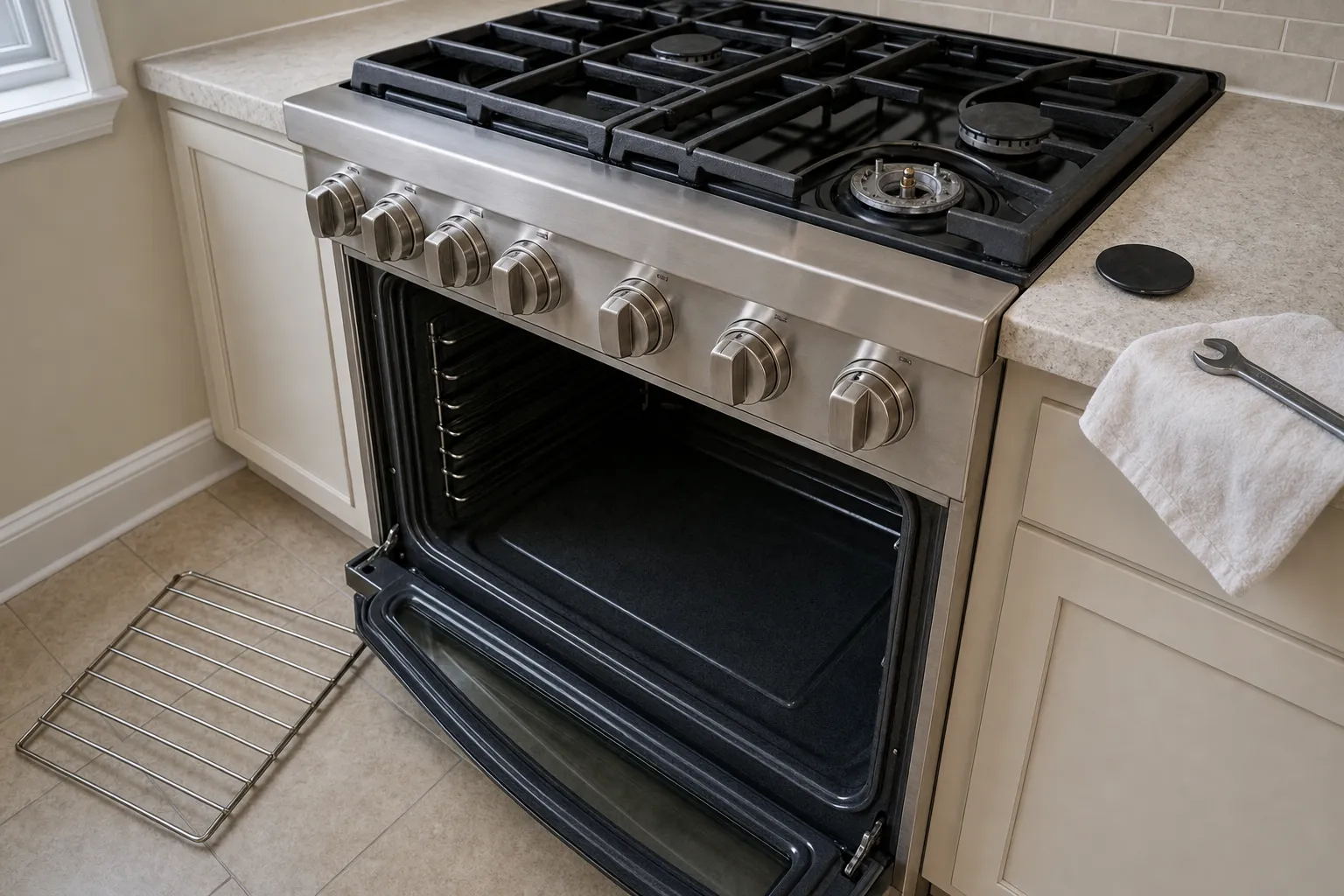
A Wolf sealed burner that clicks and clicks without ever catching is the most common call we take in Kirkland kitchens. It is also the fault most often pinned on the wrong part — usually a failed igniter or a dead spark module. In practice the electrode is generally doing its job. What has broken down is the meeting between gas and spark: the two have to arrive together, and something is keeping them apart. Far more often than not, that something is mechanical, cheap and in plain sight.
What the clicking actually is
The click is a high-voltage spark jumping from the igniter electrode to the burner. The spark module produces it when the switch behind the knob closes as you push and turn to Hi. On a current Wolf range each burner is lit on its own; Wolf notes that some earlier R and RT series ranges may click on several burners at once, and on those that is how they were made.
Once the burner lights, the electrode keeps watching it: Wolf describes a change in the electrical path between electrode and flame as the signal to try again, which is the automatic reignition. So if you hear a healthy, rhythmic click, three things are already proven: the module has power, the electrode is receiving high voltage, and the switch inside the knob is closing. The fault is downstream of all of it.
Why a burner sparks but never catches
Gas has to arrive at the electrode tip in the right concentration. Anything that disturbs the geometry of the burner head or blocks the ports interferes with that, and the list of culprits is short.
- A burner cap sitting off-centre. This is far and away number one. A cap that is tilted, or pushed even slightly off-centre, leaves the flame ports out of line with the electrode. It will spark forever and never catch.
- Water in the burner head. After a spill, a boil-over or a thorough clean, liquid sits in the well under the cap. It has to evaporate before the gas mixture will ignite. A range that stopped lighting the day after a deep clean is nearly always this.
- Blocked ports. Carbonised sugar, oil or a spilled sauce bakes into the slots around the cap edge. A partially blocked burner will light unevenly or only on high; a fully blocked one will not light at all.
- A cracked electrode insulator. The white ceramic body can hairline-crack from a knock or a pan lid. The spark then shorts to the burner base instead of crossing the gap. You will often see the arc landing in the wrong place if the room is dark.
- No gas at that burner. Rare, but it happens after a propane tank swap, a meter change, or work done on the line. If nothing on the range lights and the oven is also dead, look at the supply, not the range.
The three checks worth doing yourself
None of these need tools and all three are safe with the gas off.
One: lift and re-seat every cap. Take the cap off, dry the well and the underside with a cloth, and set it back flat and centred. It should not rock. Do this on the burners that work as well — a comparison tells you what “correct” looks like on your model.
Two: wash the burner, not the holes. Wolf’s routine for surface burners is a mild detergent or a spray degreaser, then a rinse with water and a towel dry; a soft brush helps with anything baked on. Nothing goes into the ports themselves — no pin, no wire, no drill bit. A port that has been widened or burred changes the flame for good, and that is where a lazy orange flame starts.
Three: give it drying time. If a clean or a spill preceded the fault, leave the burner apart overnight. A surprising number of “dead” burners fix themselves in twenty-four hours because all that was ever wrong was moisture bridging the spark gap.
If the burner lights after any of those, nothing has failed and there is nothing to buy.
When the spark module is genuinely at fault
The module earns the blame it usually does not deserve in three specific patterns. The first is no clicking at all on any burner, with the range otherwise powered — that points at the module or its supply. The second is clicking that carries on after a steady flame is showing: a knob that stays pushed in, a wet or cracked electrode, or less often the module itself. The third is clicking with every knob at Off, which Wolf traces first to a stuck knob, then to a power reset at the breaker, and then to the wiring of the outlet.
Those are meter jobs. We check the manifold pressure first, because a range that is being starved by a partially closed shut-off valve or an undersized regulator will produce exactly the same symptoms as a tired module, and swapping the module fixes nothing.
What it usually costs to put right in Kirkland
Most burner-ignition calls in Kirkland end as a diagnostic plus a clean and re-seat, or a single electrode assembly. An electrode is an inexpensive part and a straightforward swap once the top is off. A spark module is dearer but still a long way short of a new cooktop, and we quote both parts and labour as one figure before anything is dismantled.
The jobs worth calling immediately rather than experimenting with are these: a smell of gas at any point, a burner that lights with a whoosh or a delayed pop, flames that lift away from the ports, or soot appearing on the pan bottoms. Each of those points at a combustion or supply problem rather than an ignition one, and none of them improves by being left alone.
Common follow-ups
Should I keep turning the knob while the burner clicks?
For a few seconds, yes. If it has been clicking and releasing gas for more than about ten seconds, turn the knob off, let the area clear for a minute and try once more. Smell gas at any point? Knob off, then get everyone out without touching a light switch, and phone 911 or Puget Sound Energy once you are outdoors. Ring us when it has been made safe.
Why do all the burners spark when I only turn one knob?
It depends on the range. Wolf says each burner on a current range lights individually, but that some earlier R and RT series units can click on several burners when one is lit. On an older R series that is simply how it was built; on a newer range, every burner sparking together points at a knob switch or the spark module.
Can a deep clean cause this?
It is the single most common trigger we see. Caps get put back a few millimetres off, water sits in the burner head, or degreaser wicks into the electrode boot. Give it 24 hours to dry and re-seat every cap squarely before assuming a part has failed.